
WHAT CAN PLYOMETRICS DO FOR YOUR OTHER FITNESS GOALS?
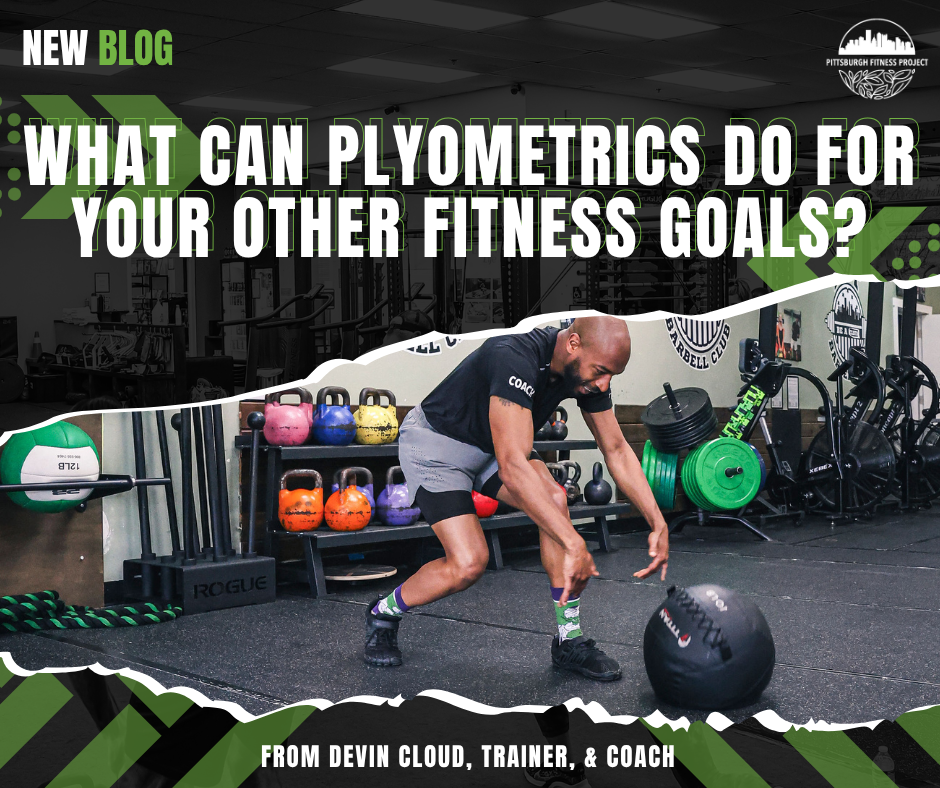
Whenever we are looking to improve our overall fitness and athleticism, we look to strength training and some sort of activity or sport-specific training to complement it. There is a widely used style of training known as plyometric training. What is plyometric training? It is a style of training where a person uses rapidly loaded movement patterns that elicit a very strong elastic response from our muscles to create high forces and speeds. Exercises for the lower body, like jumps, hops, skips, and the upper body, like throws and slams, are excellent ways to produce these high forces and speeds in these movement patterns. Most sports like football, baseball, hockey, and so many others require rapid force production from your muscles. On the other end of the spectrum, sports like distance running require more low-intensity plyometrics to be performed over and over to create efficient and smooth locomotion of the body. Let’s talk about how they can fit into your other training and what they can do for your outcomes.
The Types
We will start with the types of plyometrics and how you can work them into your training. There are three main types we can look at here, and they can be distinguished by their “intensity”. In this example, intensity refers to the amount of effort it takes to perform and execute them well, in addition to the toll they take on the body.
Low-intensity - single and double leg pogo jumps in place, jumping jacks or jumping rope, lateral hops or skater hops
Medium-intensity - medball floor slams, plyometric push up (no clap), box jumps, vertical jump and reach
High-Intensity - Maximal overhead medball throws and chest passes for distance, broad jump and triple jumps, bounding, depth drops and jumps
For those who want to get better at sports or even other forms of strength training, all types of plyometrics can be helpful with increasing force production and power. If your sport requires sprinting or change of direction, these plyometrics can provide incredible benefits, making your movements more efficient and powerful.
In a Bit More Detail
Low-intensity movements can be performed daily as they don’t require a lot of overall effort, and they can build a lot of elasticity and resilience in the lower leg. This is a great base for athletes to build up and prepare their bodies for more intense work in the gym or in their sport. Medium-intensity movements can be performed up to two times per week as they require more effort than low-intensity ones, but they don’t require a lot of work on the landing aspect. The “landing” aspect in a plyometric requires the most force on the body as gravity intensifies the landing, and it takes more work to resist it. The last, of course, would be high intensity. These should only be performed once a week if they are being done with the proper intent. These variations require high speeds and forces to be done properly, and therefore they need more recovery in between the bouts. Although they can have a great carryover to your sport and are totally worth it. For each variation, the athlete can perform 2-5 sets of anywhere from 3-20 repetitions. Low-intensity work is on the upper end of sets and reps, while medium- and high-intensity work is on the lower end of total volume.
Plyometrics for Endurance Athletes
Now let’s look at what plyometric training can do for endurance athletes like runners. Running as an activity requires repeated low-intensity plyometric movements. The foot must strike, disperse force, then rapidly produce it again. Over time, this can start to become less efficient because the surrounding muscles and tendons can’t produce the necessary forces to maintain the actions and positions. With a combination of strength training and plyometrics, one can improve the output of the muscles and tendons to make running stronger and more efficient. The runner will feel more elastic and springy in their stride, making running easier overall. Runners can use single-leg and double-leg hops and skips to build up their feet, ankles, and calves to supplement their training for their runs. Use these types of movements daily as warm-ups or even as working sets in a gym workout to improve the skill overall. If you want any more in-depth help with plyometric training, book an assessment now with one of our trainers at PFP!