
HOW FASCIAL STRETCH THERAPY CAN HELP EVERYONE MOVE BETTER
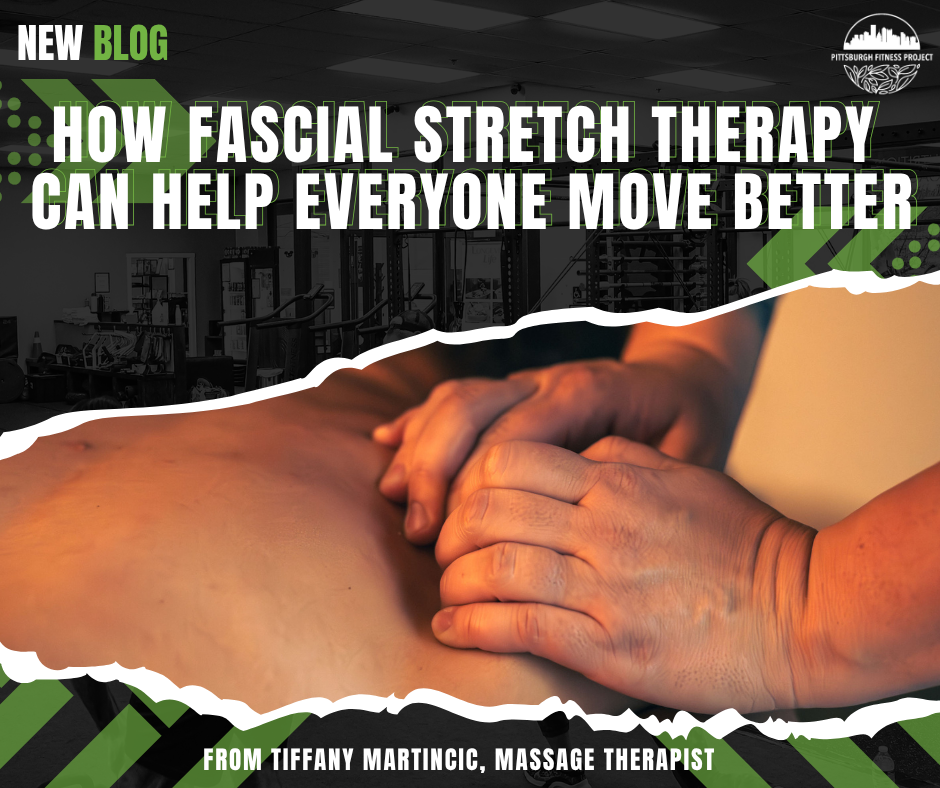
Let’s be honest: most people do not think about mobility until something starts feeling tight, stiff, cranky, or just plain annoying. Maybe your hips complain when you stand up. Maybe your shoulders feel like they belong to someone twice your age after sitting at a desk all day. Maybe you stretch and somehow still feel tight five minutes later. That is where Fascial Stretch Therapy (FST) comes in — and why so many people are paying attention to it.
But What is FST?
Developed through Stretch to Win, Fascial Stretch Therapy focuses on more than just muscles. It targets the fascia — the connective tissue that wraps around muscles, joints, nerves, and basically everything that helps your body move as one connected system. Think of fascia like the body’s internal webbing. When it gets restricted, movement can feel limited, stiff, or uneven — even if you are technically “stretching enough.” According to Stretch to Win, the goal is not to force muscles longer, but to work with the nervous system and joints in a way that helps the body move more naturally and comfortably.
It’s Not Just Stretching…It’s Smarter Stretching
Traditional stretching often focuses on one muscle at a time: hold, breathe, count to thirty, hope for the best. Fascial Stretch Therapy takes a different route. Instead of pulling one muscle in one direction, FST uses gentle traction, rotation, and movement through multiple planes. That matters because your body does not move in straight lines all day — you twist, reach, bend, rotate, and shift constantly.
Research on fascia suggests that connective tissue responds best when movement is dynamic and varied rather than isolated (Schleip et al., 2012). Basically: your body likes variety more than old-school toe touching.
Your Joints Love a Little Space
One of the standout ideas behind FST is joint decompression. Before stretching tissue, gentle traction is often applied to create space in the joint. That can help reduce the feeling of compression many people carry in areas like hips, shoulders, and spine. And honestly, who does not want their joints to feel like they can breathe a little?
Stretch to Win teaches that when joints feel less compressed, the nervous system often allows movement more easily because the body senses less threat. Translation: less guarding, less tension, better movement.
It Is Great for Athletes… But Also Great for People Who Just Sat Weird for Three Hours
You do not need to run marathons or deadlift twice your body weight to benefit from mobility work.
FST can help:
desk workers with stiff necks and hips
parents carrying kids and bags like it is an Olympic sport
active adults recovering from workouts
older adults trying to move with more ease
anyone whose body suddenly says “absolutely not” when reaching overhead
Because fascia connects the whole body, restrictions in one area often show up somewhere unexpected. That tight hamstring? Sometimes the problem starts higher up. That cranky shoulder? It may not be just your shoulder. Bodies are dramatic like that.
Breathing Is Secretly Doing a Lot of Work
Another key piece of FST is breathing. Slow breathing helps calm the nervous system, which tells your muscles and fascia they do not need to hold on so tightly. A relaxed nervous system often equals better mobility. Which means yes — breathing actually counts as productive work.
Why People Often Feel Better Immediately
Many people notice they move differently right after a session because FST combines:
nervous system regulation
joint mobility
fascial movement
assisted stretching
It is not just about flexibility — it is about improving how your body organizes movement. And sometimes that means standing up afterward and thinking, “Wait… why does walking feel easier?”
The Bottom Line
Mobility is not only for athletes or people in pain. It is for anyone who wants everyday movement to feel easier, smoother, and less restricted. Fascial Stretch Therapy offers a full-body approach that respects how connected the body really is — and that is why it can be helpful whether you are training hard, sitting too much, or simply trying to age without sounding like bubble wrap every time you stand up. Because moving better should not feel complicated - and your hips deserve better than surviving on occasional toe touches. Sign up for a Massage today and ask your therapist about FST!
⸻
References
• Stretch to Win — Fascial Stretch Therapy principles and methodology
• Schleip R, Findley TW, Chaitow L, Huijing P. Fascia: The Tensional Network of the Human Body. Elsevier, 2012
• Wilke J, Krause F, Vogt L, Banzer W. What is evidence-based about myofascial chains? Archives of Physical Medicine and Rehabilitation. 2016