
GETTING STRONGER FOR REAL LIFE
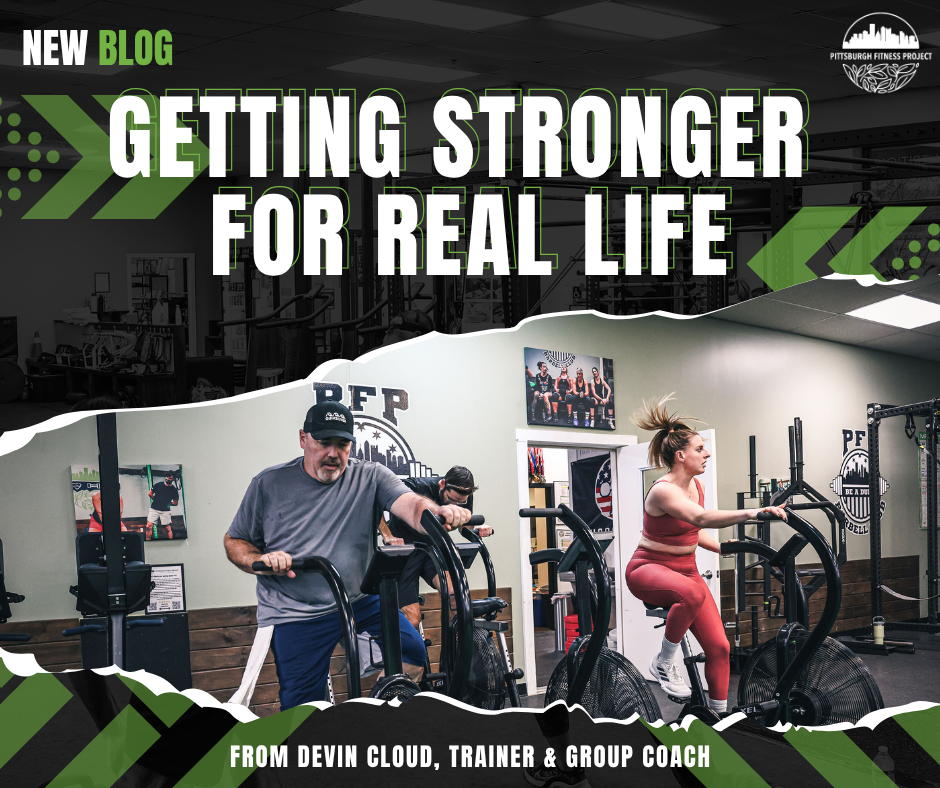
What does getting stronger actually mean for us as people? Many view strength or getting physically stronger as only something that avid gym-goers do to increase the number on a barbell or dumbbell. They may see it as unnecessary or a waste of time in their daily life. It is quite the contrary. A strong and healthy body can extend to help with so many things in our daily life. Whether it is making tasks easier, improving our self-efficacy and autonomy, or even just making it easier to enjoy ourselves. Getting stronger for real-life looks like a lot of things for different people, but let’s discuss some approachable methods you can use to get stronger for real-life things and situations.
Making Tasks Easier
Let’s address the first point here, which is making tasks easier. Most of us throughout the day might have to pick something heavy up off the ground, or in more extreme circumstances, help pick up a person off the ground. A great exercise for improving this would be any deadlift variation. Deadlifts are a great compound exercise that involve the entire body. It strengthens all the muscles of the posterior chain of our body: hamstrings, glutes, spinal erectors, and trapezius muscles, which can often go untrained even by many people who work out consistently. It also trains your grip, making it easier to pick up other heavy objects, like when you’re doing yard work, cleaning your house, or moving furniture.
Aiding in Daily Life
Squatting and pressing movements also help tremendously in our daily lives. Movements like back squats and front squats promote strength in our lower body while simultaneously building great core strength due to you stabilizing the weight on our shoulders or in your hands. Pressing movements improve our upper-body strength so that we can perform tasks like lifting things over our heads into cabinets or shelves. If you're an older individual, it can make falls easier to recover from or prevent their severity. Stronger leg and arm muscles are better at stabilizing joints making someone less likely to fall and hurting themselves. Using barbells or dumbbells for overhead presses, bench presses, or rowing variations like bent over rows or racks for pull-ups are fantastic ways to build your upper body for whatever demands you have in daily life.
Getting Stronger
Improving autonomy and self-efficacy go hand-in-hand with getting stronger. When we get stronger this not only physically makes life easier but also changes our mentality towards ourselves and our lives. A stronger body means we can increase the ability to do things for ourselves. We rely less on others for help and become more capable in our own right. Say you’re an older individual living alone or even with another older individual who is your partner. If you both or even just one of you maintains your strength later in life, this increases your chances of maintaining your autonomy by a large measure. If your likelihood for injury is low you can still go to the store on your own, bathe yourself effectively, move around your home without fear, this will help you so much. Let's take an easy example like walking up and down stairs in your house. Exercises that involve using predominantly one leg, like step-ups, single-leg squats, and lunges, can make stairs a non-issue for you. Also getting stronger on one leg makes balance and coordination so much easier for you.
Making Life More Enjoyable
The last part here is about making life enjoyable. Say you and your family want to go on vacation and they want to walk on a beach or go hiking somewhere. Getting stronger means you can have those moments with your family. Those steep hills and trees or rocks to grab on to suddenly don't seem as daunting when we feel stronger. If nothing else, getting stronger just means you get to do the things you love for longer and that's definitely worth it.
You don’t have to dive in headfirst. Start out and go to the gym 1 or 2 times a week for 30 mins. Grab some dumbbells, barbells, hop on a machine and do a couple sets of an exercise. Make sure it is sufficiently difficult and break a sweat. There’s no season or hard deadline. Strength is a long game, built through consistency and patience. If you want someone to guide you through it all come see us at PFP and book an assessment, we are here to help!