
CLEAN TECHNIQUE ESSENTIALS
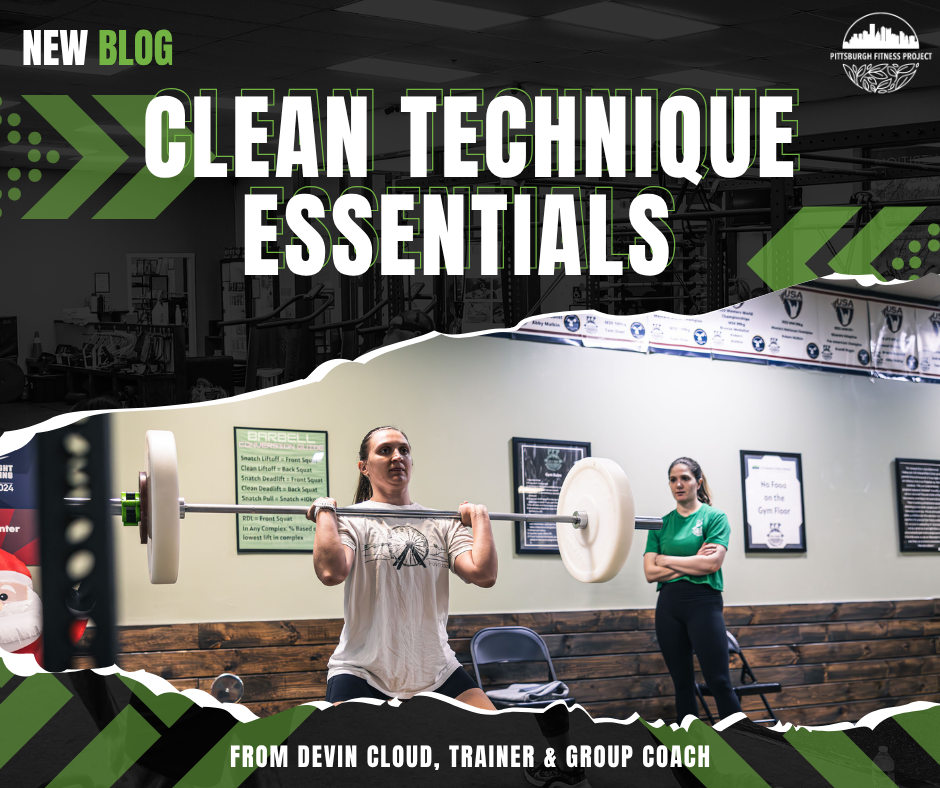
The clean, much like snatching in weightlifting, requires not only power and strength, but good rhythm and timing. In order to execute it properly, we are going to go over some key technical aspects as well as some ways to internalize those cues and output them in your training sessions. We will highlight the overall goals first and then break down how we can ensure they're occurring in the lift properly.
Overall Goals for Good Clean Technique
● Bar must stay close to the body, space is the enemy here
● Relaxed arms in the initial pull
● Timing to get to the catch position
Bar Stays Close
We are going to talk about the lift from the floor up so that way we can highlight where the bar is at each position of the lift. When we start the lift we want the bar to be positioned somewhere between our midfoot and the ball of our foot. This ensures the bar is underneath our center of mass. This allows us to move it in the most efficient path possible. Our start position has our hips and knees bent and our back is flat. Knees below hips, hips below shoulders and our back is flat with long arms. From here we press down down hard into the floor and the bar moves to our knee with the knees opening up from their initial bend. This is the “first pull”. From here the bar has moved so that it is over the front of our ankle. Feet are flat and you should feel tension in your hamstrings. From here we keep pushing down until we can feel the bar come up to our hip with it staying very close to our thighs. The “second pull” is now complete and we are starting to extend our hips and knees and drive the bar up into the “third pull” which we will talk about next. If executed well you should feel the bar very close to your legs the entire time.
Relaxed Arms
This can sometimes be a hard concept to understand without feeling it for yourself. The analogy we use is the hands are like hooks and the arms are like ropes. We want to have long tense ropes that connect us to the bar. This passive tension allows our lower body to accelerate the bar properly. Once we reach that “third pull”, which is where our arms become active, then the “ropes” are used to pull us underneath the bar. So throughout the whole lift, we want our arms positioned in such a way that our knuckles are pointed at the ground, and our elbows are turned out to the side. This is especially important in the “third pull”. Once our legs drive the bar up we raise our elbows as we pull our body down to the bar. When the bar is driven up it acts as if it is a stationary object and we pull ourselves against it. We coach our lifters at this point to drive their elbows and knees up at the same time. This allows us to move quickly under the bar and catch the bar at its highest peak of its path. This leads us to our final point, good timing.
Rhythm and Timing
Good rhythm and timing comes from us moving our bodies in accordance with where the bar is in space. In the “third pull” we want to rotate our hands and wrists to get our elbows around and catch the bar on our shoulders in what we call a “front rack” position. In order to have good timing here we want the bar to land on our shoulder when our feet contact the floor in our catch position. In our “third pull” once we extend our knees lift slightly and our feet contact the floor again, usually slightly wider than where we started. This is typical in the clean because we land in a position similar to a front squat. The rhythm aspect of this is we want to meet the bar at its highest point of its vertical path. If we imagine the bar moving in a slightly arced path in its acceleration there’s a point where the bar reaches an apex and is essentially “weightless”. This is where it is easiest to catch the bar because it has no acceleration coming back down. This is way easier said than done but with practice you can feel where you are in relation to the bar and pull yourself to this point. We call this “meeting the bar”. This can be practiced even with an empty bar. We start tall with the bar in our hands and we cue “ knees and elbows together” both of these elevate at the same time and we catch the bar on our shoulders.
In summary, keep the bar close, arms long and relaxed, and meet the bar at its highest point. You can get all of this and more when you book a barbell assessment with one of our great coaches!